 Add to Chrome
 Add to Firefox
 Add to Edge
Prompt-Unknown Promotion Attacks against LLM-based Sequential Recommender Systems
Apr 26, 2026
Large language model-powered sequential recommender systems (LLM-SRSs) have recently demonstrated remarkable performance, enabling recommendations through prompt-driven inference over user interaction sequences. However, this paradigm also introduces new security vulnerabilities, particularly text-level manipulations, rendering them appealing targets for promotion attacks that purposely boost the ranking of specific target items. Although such security risks have been receiving increasing attention, existing studies typically rely on an unrealistic assumption of access to either the victim model or prompt to unveil attack mechanisms. In this work, we investigate the item promotion attack in LLM-SRSs under a more realistic setting where both the system prompt and victim model are unknown to the attacker, and propose a Prompt-Unknown Dual-poisoning Attack (PUDA) framework. To simulate attacks under this full black-box setting, we introduce an LLM-based evolutionary refinement strategy that infers discrete system prompts, enabling the training of an effective surrogate model that mimics the behaviors of the victim model. Leveraging the distilled prompt and surrogate model, we devise a promotion attack that adversarially revises target item texts under semantic constraints, which is further complemented by the highly plausible, surrogate-generated poisoning sequences to enable cost-effective target item promotion. Extensive experiments on real-world datasets demonstrate that PUDA consistently outperforms state-of-the-art competitors in boosting the exposure of unpopular target items. Our findings reveal critical security risks in modern LLM-SRSs even when both prompts and models are protected, and highlight the need for more robust defensive means.

Diversity-aware Dual-promotion Poisoning Attack on Sequential Recommendation
Apr 09, 2025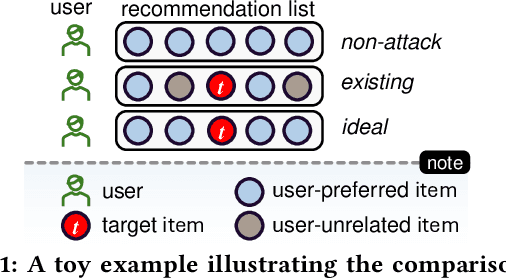
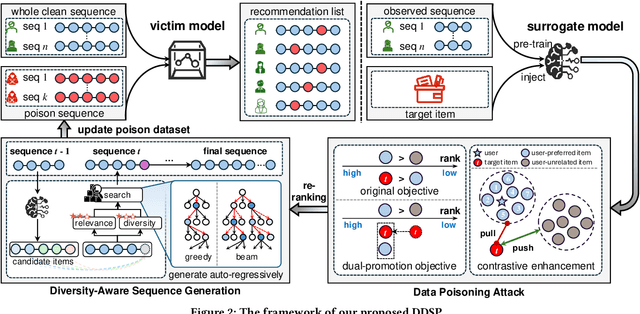
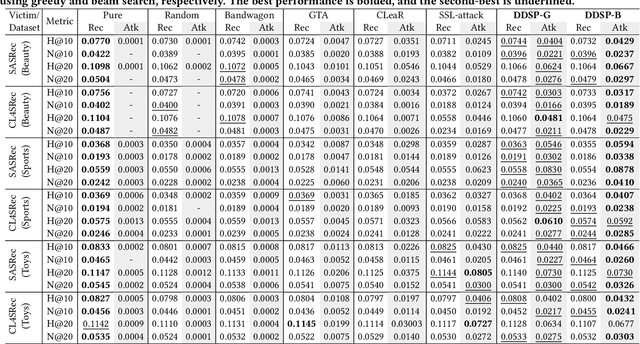
Sequential recommender systems (SRSs) excel in capturing users' dynamic interests, thus playing a key role in various industrial applications. The popularity of SRSs has also driven emerging research on their security aspects, where data poisoning attack for targeted item promotion is a typical example. Existing attack mechanisms primarily focus on increasing the ranks of target items in the recommendation list by injecting carefully crafted interactions (i.e., poisoning sequences), which comes at the cost of demoting users' real preferences. Consequently, noticeable recommendation accuracy drops are observed, restricting the stealthiness of the attack. Additionally, the generated poisoning sequences are prone to substantial repetition of target items, which is a result of the unitary objective of boosting their overall exposure and lack of effective diversity regularizations. Such homogeneity not only compromises the authenticity of these sequences, but also limits the attack effectiveness, as it ignores the opportunity to establish sequential dependencies between the target and many more items in the SRS. To address the issues outlined, we propose a Diversity-aware Dual-promotion Sequential Poisoning attack method named DDSP for SRSs. Specifically, by theoretically revealing the conflict between recommendation and existing attack objectives, we design a revamped attack objective that promotes the target item while maintaining the relevance of preferred items in a user's ranking list. We further develop a diversity-aware, auto-regressive poisoning sequence generator, where a re-ranking method is in place to sequentially pick the optimal items by integrating diversity constraints.